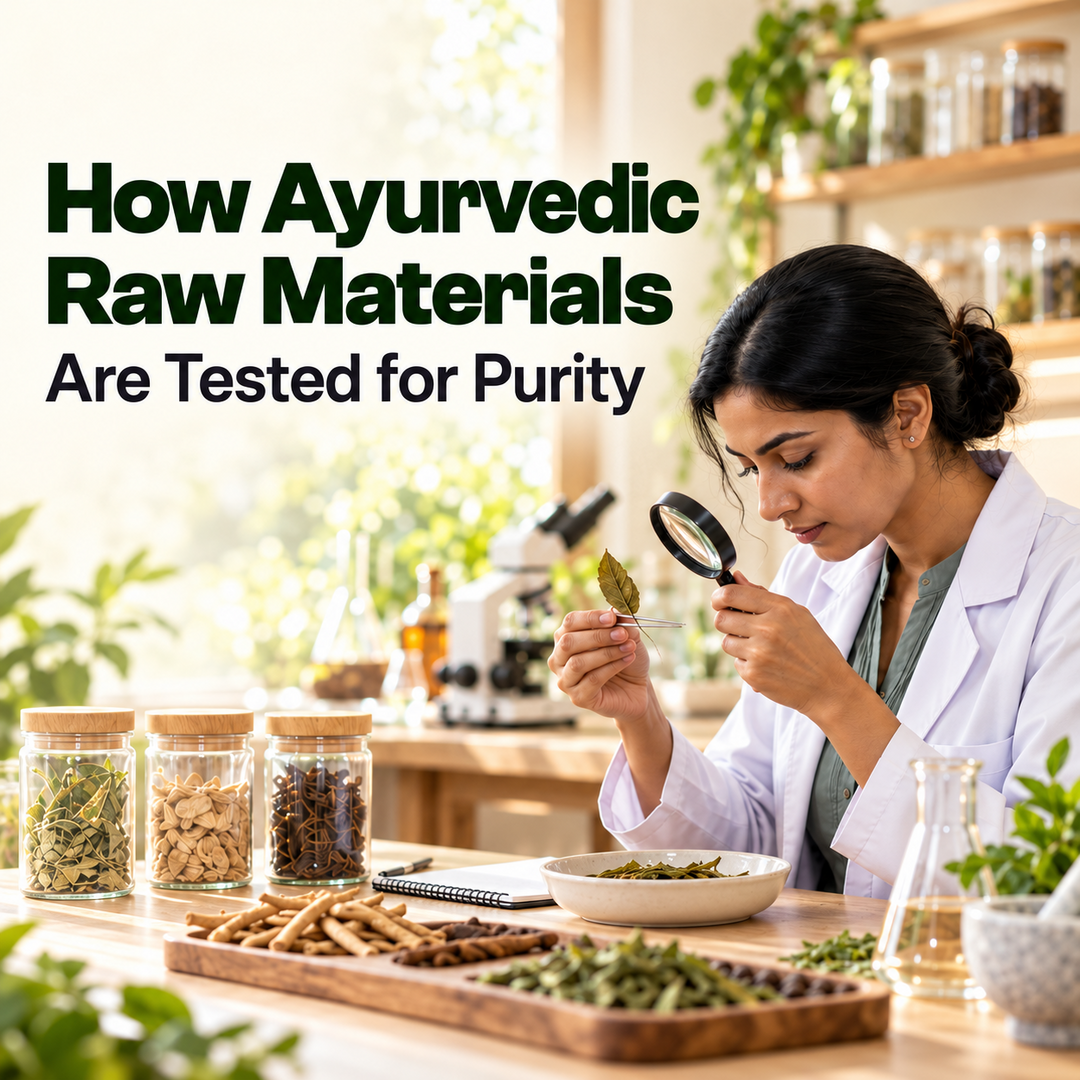

Two bottles of herbal oil can look the same, smell the same and carry similar labels. Yet one may have been tested for identity, heavy metals and microbial safety, while the other may never have been checked beyond a visual inspection. For anyone buying natural products, this gap is the biggest hidden risk. A Certificate of Analysis (COA) closes that gap by giving you documented proof that a specific batch was tested against defined quality limits. In this guide, you’ll learn what a COA contains, which tests matter for Ayurvedic and herbal products, how to read one, and why certificate of analysis products deserve a higher level of trust.
Quick answer: A Certificate of Analysis is a batch-specific quality report issued by a laboratory or quality control department. It lists the tests performed on a product batch, the acceptable limits and the actual results, confirming whether the batch meets its specifications.
 What Is a Certificate of Analysis (COA)?
A COA is a formal document that confirms a particular batch of a product has been tested and meets its approved specifications. The key word is batch. A factory certificate tells you how a company works in general. A COA tells you what was found in one specific lot of one specific product.
COAs are used at several points in the supply chain: for raw materials arriving at a factory, for finished products leaving it, and for export shipments where buyers and regulators require proof of quality.
 What Information Does a COA Contain?
A complete COA normally includes:
|
Section |
What it tells you |
|
Product name and code |
Exactly which product was tested |
|
Batch or lot number |
Links the report to the physical batch |
|
Manufacturing and expiry dates |
Confirms the batch is within shelf life |
|
Specification |
The standard the product must meet |
|
Test parameters and methods |
What was tested and how |
|
Results |
The actual measured values |
|
Conclusion |
Pass or fail against each limit |
|
Authorisation |
Signature of the analyst or QC head, with date |
 Which Tests Matter for Herbal and Ayurvedic Products?
Herbal products come from plants, and plants naturally vary with soil, climate and harvest time. Testing is what turns that variation into consistency. Common tests include:
1. Identity and authenticity
Confirms the correct herb or ingredient was used. Methods include organoleptic checks (appearance, smell, taste), microscopy and chromatographic fingerprinting such as HPTLC, which compares the product’s chemical profile with a reference standard.
2. Physicochemical parameters
Moisture or loss on drying, total ash, acid-insoluble ash, extractive values, pH, and for oils, values such as acid value and refractive index. These show purity and detect adulteration or poor processing.
3. Heavy metals
Lead, arsenic, mercury and cadmium are tested because plants can absorb metals from soil and water. Atomic Absorption Spectroscopy (AAS) is commonly used for this.
4. Microbial safety
Total aerobic count, yeast and mould count, and absence of harmful organisms such as E. coli and Salmonella.
5. Pesticide residues and aflatoxins
Particularly important for raw herbs and powders, which can be affected by farming practices and storage.
6. Assay of marker compounds
For many herbal products, key compounds are measured using HPLC or GC to confirm that each batch delivers consistent composition.
 Why Certificate of Analysis Products Deserve More Trust
Choosing certificate of analysis products is not about paperwork. It is about reducing risk:
-
Safety: contaminants and microbes are checked before a product reaches you.
-
Consistency: every batch is measured against the same specification.
-
Authenticity: identity tests protect against substitution of costly herbs with cheaper ones.
-
Traceability: the batch number lets a company trace any concern back to raw materials and process records.
-
Transparency: brands that document test results are open about their quality.
-
Regulatory readiness: export markets often ask for a COA with every consignment.
 COA vs GMP, ISO and WHO-GMP: What’s the Difference?
These documents are often confused, but they answer different questions:
|
Document |
What it proves |
Scope |
|
COA |
A specific batch meets its specifications |
One batch of one product |
|
GMP / WHO-GMP |
The facility follows good manufacturing practices |
Factory and processes |
|
ISO 9001 |
A quality management system is in place |
Organisation-wide |
|
HACCP / FSSC 22000 |
Food safety hazards are controlled |
Food-grade production |
The strongest quality story combines all of them: certified facilities show how products are made, and the COA shows what a given batch actually contains. See our guide on the importance of WHO-GMP and COPP certification.
 How to Read a COA and Spot Red Flags
Check these items:
-
The product name and batch number match your pack.
-
The test date falls within a reasonable window of the manufacturing date.
-
Every parameter has a stated limit, not just a result.
-
Each result is within its limit.
-
The report is signed and issued by a QC department or a recognised laboratory, such as one accredited under ISO/IEC 17025 (NABL in India).
Red flags:
-
No batch number or a generic, non-batch report
-
Results without limits
-
Missing dates or signatures
-
“Passes” or “complies” written without actual values
-
A report that does not match the product you hold
 Vasu Healthcare’s Testing and Quality Infrastructure
Vasu Healthcare follows an Own Formula, Own Manufacturing, Own Research approach. Its Vasu Research Centre (VRC), accredited by the Department of Scientific & Industrial Research (DSIR), Government of India, is equipped with HPTLC, Flash Chromatography, HPLC, Gas Chromatography and Atomic Absorption Spectroscopy, which are the same techniques used for identity testing, marker assays and heavy-metal analysis.
The company’s manufacturing units hold certifications including ISO 9001:2015, WHO-GMP, GMP (OTC), HACCP, FSSC 22000, BRC, Halal India and Cruelty Free, listed on our Certification & Accreditation page. Learn more about our Research & Development, Quality Policy and Ingredients We Don’t Use.
[Confirm: how trade partners and customers can request a batch COA, such as an email address or a process.]
Products made under this quality system include Vasu Kumkumadi Tailam, Vasu Swarnaprashan Drops for Kids and the Trichup hair care range.
Conclusion
A Certificate of Analysis turns a quality promise into documented evidence. When you evaluate certificate of analysis products, look for batch-level testing, clear limits, signed reports and facility certifications such as GMP and ISO. Together they show that a brand takes purity, safety and consistency seriously. Explore our quality commitments on the Certification & Accreditation page, or shop tested herbal and Ayurvedic products at VasuStore.
Frequently Asked Questions
Is a COA the same as a lab report?
A COA is a formal, batch-specific summary of lab results that has been approved by quality control. A raw lab report may contain more technical detail.
Does every batch need its own COA?
Yes. Raw materials and conditions can differ between batches, so each is tested and documented separately.
Can consumers ask for a COA?
Many brands provide COAs to trade partners and on request. Always quote the batch number printed on the pack.
Does a COA prove that a product works?
No. A COA confirms identity, purity and safety against set limits. It does not prove a health benefit.
Is a COA required for Ayurvedic products?
Manufacturers must follow quality and GMP requirements under Indian regulations, and COAs are a standard part of quality documentation and export compliance.