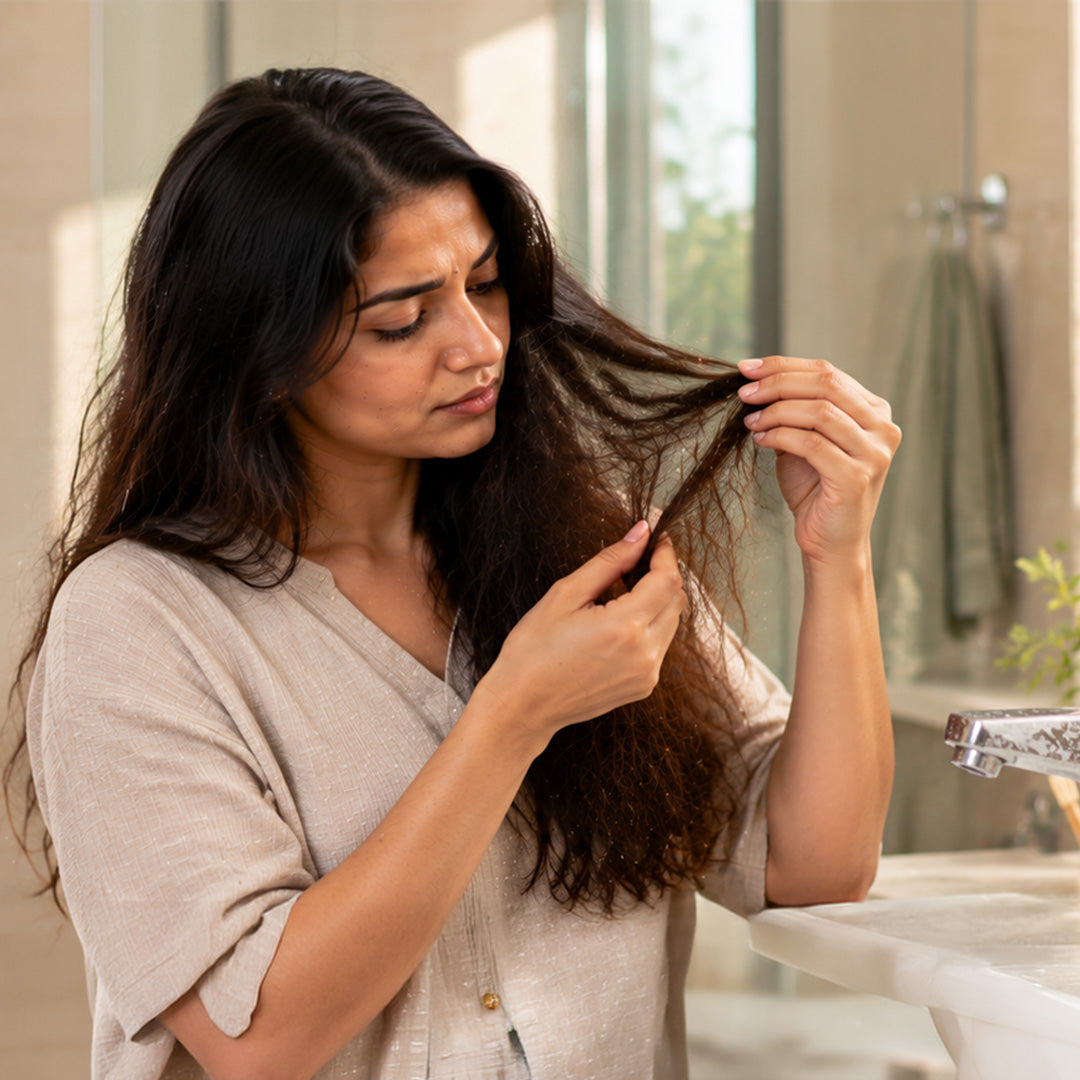

Moisture protein balance hair care is the real reason your hair feels like straw on some days and limp noodles on others. You've tried the keratin shampoo, the curd-and-egg mask your mother swears by, and three different serums, yet the confusion over moisture vs protein for hair remains. The answer is understanding whether your strands need more hydration, more strengthening, or simply a break from both. Instead of guessing, start with the quick check below.
 Step 1: Take the 60-Second Hair Check
Wash your hair with a mild shampoo, skip styling products, and answer these while it's damp:
-
Does a single strand stretch a little and spring back? (Balanced)
-
Does it stretch a lot, feel gummy and not return? (Needs protein)
-
Does it barely stretch and snap quickly? (Needs moisture)
-
Does your hair feel stiff even after conditioner? (Too much protein)
-
Has your hair been bleached, coloured, rebonded or smoothened in the last year? (Likely needs both)
This informal stretch test is a starting point, not a diagnosis. It works best alongside how your hair behaves day to day, and it is the simplest answer to how to tell if hair needs protein.
Step 2: Find Your Hair Profile
Profile A: Thirsty Hair (Needs Moisture)
What it feels like: rough, dull and frizzy, especially in Delhi winters or after long AC days; tangles easily.
What helps: conditioner after every wash, a weekly mask, and pre-wash oiling. A hair care routine for dry frizzy hair also means limiting straighteners and patting hair dry instead of rubbing.
Profile B: Weak, Over-Stretchy Hair (Needs Protein)
What it feels like: limp, mushy when wet, with breakage that shows up as short broken strands rather than hair fall from the root. Common after rebonding, smoothening or repeated colouring.
What helps: an occasional protein treatment for damaged hair, with hydrolyzed keratin, rice, wheat or silk protein high on the label. A review of hair cosmetics notes that these small hydrolyzed proteins can temporarily increase hair strength. The effect washes out gradually, so treatments are periodic, not one-time fixes.
Profile C: Stiff, Brittle Hair (Protein Overload)
What it feels like: stiff, straw-like hair that snaps even after conditioning. These are classic signs of protein overload in hair, often from layering a protein shampoo, mask and leave-in together.
What helps: pause protein products for a few washes and focus on moisture and oils. Softness usually returns within one to two weeks.
Why Indian Hair Oiling Actually Has Science Behind It
Hair oiling is the one practice where Indian tradition and lab research clearly meet. Researchers at Marico's R&D centre in Mumbai compared coconut, sunflower and mineral oils on hair. Coconut oil was the only one that significantly reduced protein loss in both damaged and undamaged hair, whether used before or after washing. Its main fatty acid, lauric acid, has a small, straight structure that lets it enter the hair shaft. Mineral oil, still common in many Indian hair oils, did not reduce protein loss.
That makes coconut oil for hair protein loss one of the best-supported home habits. It also changes the moisture-versus-protein question: oiling before washing helps protect the keratin you already have.
How to oil well:
-
Warm the oil slightly and apply it to the lengths and ends, where damage builds up.
-
Leave it on for 30 minutes to a few hours before washing.
-
Don't over-scrub the scalp to remove oil; a double wash with mild shampoo works better.
The Ayurvedic View: Keshya Herbs and Shiro Abhyanga
Ayurveda groups hair-nourishing herbs as keshya dravya. Bhringraj (Eclipta alba), amla, hibiscus (japa), methi and brahmi are traditionally infused into sesame or coconut oil for shiro abhyanga, the Ayurvedic head massage. Traditionally, dry, rough hair is linked to aggravated Vata, which is why warm oil is used to counter dryness.
These descriptions come from classical practice. Modern research on individual keshya herbs is still limited, but gentle oiling and massage are low-risk ways to add slip and reduce friction.
What about traditional "protein" packs like curd, egg or methi paste? They contain protein, but whole-food proteins are far larger than the hydrolyzed proteins in formulated products. They mostly coat the hair rather than reinforce it. They can still feel lovely, but don't expect salon-level repair.
Understanding Hair Porosity in Indian Conditions
Hair porosity is how easily your hair absorbs and releases water.
|
Porosity |
Signs |
Best approach |
|
Low |
Water beads on hair; oil sits on top |
Light oils, warm towel while conditioning |
|
Medium |
Absorbs and holds moisture well |
Simple, consistent routine |
|
High |
Absorbs fast, dries fast; often chemically treated |
Oiling, regular conditioning, occasional protein |
Humidity matters too. In Mumbai's monsoon, high-porosity hair can swell and frizz. In a dry North Indian winter, it loses moisture quickly and needs heavier sealing.
Your Label Cheat Sheet
|
Leans moisture |
Leans protein |
|
Glycerin, aloe vera, honey, panthenol |
Hydrolyzed keratin, rice, wheat or silk protein |
|
Shea butter, coconut or sesame oil |
Amino acids, peptides, collagen |
|
Cetyl or cetearyl alcohol (conditioning, not drying) |
Soy or quinoa protein |

Common Mistakes That Upset the Balance
-
Layering protein everywhere. A protein shampoo, mask and serum used together can tip hair into stiffness.
-
Skipping conditioner because you oiled. Oil and conditioner do different jobs, so use both.
-
Hot water rinses. Very hot water can leave hair drier. Finish with lukewarm or cool water.
-
Towel-rubbing and wet combing. Wet hair stretches and breaks more easily, so pat dry and detangle gently from the ends.
-
Changing products every week. Give a routine three to four weeks before judging it.
Moisture vs Protein for Hair Is a Routine, Not a Product
Moisture protein balance hair care comes down to reading your hair. When it comes to moisture vs protein for hair, hydrate often, strengthen only when damage demands it, and let traditional oiling do the quiet work in between. Vasu's Trichup Hair Fall Control Oil blends sesame and coconut oils with amla, licorice and bhringraj for your pre-wash ritual. You can also explore our Trichup Pro damage repair range or read how to repair damaged hair naturally.
FAQs
How often should I use a protein treatment?
Follow the product label, and reduce frequency if hair turns stiff. Many people use one every few weeks.
Is overnight oiling better than one hour?
The Marico study showed benefits with pre-wash oiling. Longer isn't proven to be better, and overnight oil can clog the scalp for some people.
Should I stop using coconut oil if my hair feels stiff?
Coconut oil can feel heavy on some low-porosity hair. Try lighter sesame- or almond-based oils instead.
Does rebonding permanently damage the protein balance?
Chemical straightening alters hair structure. Treated lengths need ongoing care until they grow out.
When should I see a dermatologist?
See one if you notice hair fall from the root, patches, scalp pain or flaking that doesn't settle.